Pages

.

Uma in the Snow


Another short video clip, this one featuring Uma the Pont-Audemer Spaniel hunting pheasants in the snow..and a rare (thank goodness) misfire due to a defective shotgun shell!


reade more... Résuméabuiyad

An Encore for Souris-Manon

 In September I wrote a post explaining that the retirement of our dog Souris-Manon from the hunting field only lasted about a week. And now that the season is over, I can happily report that she actually had one of the best seasons ever! So I've put together a photo and video retrospective of Souris-Manon's encore hunting season. Enjoy!


This summer, our nearly 14-year-old Weimaraner was laid low by pancreatitis. And when the veterinarian discovered a heart murmur, it looked as if Souris-Manon's hunting days were over.


But the smell of autumn and the promise of birds in the woods was too hard to resist. We decided to just let her hunt --come what may.  And on her very first hunt after coming out of retirement, Souris outsmarted a sharptail grouse. Click below to see the video replay.


And so, from that day to the last day of the season, Souris ran across pastures.


and in stubble fields.


Over the prairies,


and in the woods.


She found birds to point in the tall grass,


in the cattails,

and even in the snow.


She backed her hunting buddies,


and on the rare occasion when my aim was true,


she retrieved pheasants (click to play),


snipe

woodcock, grouse, ducks and geese.


But above all, Souris did what she's done every day for nearly 14 years. She put smiles on our faces and warmed our hearts.


Bravo Souris. It was a fantastic encore!!


reade more... Résuméabuiyad

Timberdoodles in Uma-Woods


With the hunting seasons winding down, I'm finding a bit more time to post blog updates, photos and videos. So here's today's project, a short video featuring our Pont-Audemer Spaniel Uma hunting woodcock in the Interlake region of Manitoba. Enjoy!


Click here to see more pix!

reade more... Résuméabuiyad

Snipe Fever!

I got out for another great snipe hunt with Henri, but this time we were joined by hunting buddies, Ross, Zeiss and Vinnie. I managed to get some shaky video of some of the highlights..and low-lights.

Enjoy!


reade more... Résuméabuiyad

Retirement Sucks! Time for a COMEBACK!

Just over a month ago our Weimaraner Souris-Manon was very, very ill after two back-to-back bouts of pancreatitis. The Vet also discovered a fairly serious heart murmur. So the decision was made that at nearly 14 years old, Souris would retire from the hunting fields.

A couple of weeks ago, after the opening day of the waterfowl season I posted this photo to announce Souris' retirement and noted that she seemed to have accepted the decision and would from now on just spend her days relaxing in the warm sun.

But then I started noticing that Souris' eyes were getting a bit brighter every day and that she was protesting a bit more each time I took the other dogs to the field. So another decision was made: retirement sucks! Souris was getting back in the game! Here is a video of her first post-retirement performance. ENJOY!!

reade more... Résuméabuiyad

Shooting Sports


Since publishing Pointing Dogs Volume One in 2011, I have to admit that I've been a bit lazy about photographing my dogs in action. For the last couple of years, I've tended to reach more for my gun to shoot birds for diner than for my cameras to 'shoot' dogs for books and articles.

But this year, I decided to get back to capturing the action with my cameras. And I've added a bit of a twist; I've vowed to shoot even more video than still images. So watch out! I'm now armed with a new Sony camcorder and the latest version of iMovie and I intent to post a video every week or two throughout the season.

Here's my latest piece. It's features my dog Henri (Silvershot's Pocket Rocket) hunting sharptails and snipe on a friend's ranch a couple of hours north of the city. As you will see, my shooting --with camera or gun -- sucks. But we had a great time despite my lack of skill. 


reade more... Résuméabuiyad

recettes de four à convection

Si vous souhaitez four à convection recettes bonne pâtisserie créée approprié, indiqué ici est une bonne convection nourriture du four. Si vous le souhaitez, vos choux à la crème convection recettes du four pourraient être organisées autant que 12 fois avant un répondeur . Vous serez en mesure de simplement Deep Freeze ces téléphones garder longue , juste garantir qu'il n'y êtes hermétique tordu . Pour aider à préparer la nourriture de vos bouffées sein de cette nourriture, il suffit de placer convection recettes du four les décongelés sur la préparation de votre linge de receipee . Assurez-vous que ceux-ci sont situés un peu de côté , en plus de se préparer à 5-8 quelques minutes au four à 300 scène.

Cette nourriture sert 10 personnes

Éléments pour cette convection nourriture du four sont généralement :

Fonds de souffle Lotion

Remplissage (vous pouvez choisir certains de ces plombages ) :

La crème glacée

Choco -Orange four à convection crème de recettes

Crème fouettée, sucrée doucement en plus de saveur

Chocolat aromatisé crème de glaciers à être mis comme un chef de file (facultatif)

Monsieur pâtissière (facultatif)

Préparation dans ce four à convection recettes convection nourriture du four:

1 . Utilisez une pelle pour diviser votre crème utiliser les fonds e -cig pour 10 monticules . Ce qui revient doit être égale à au sujet de 1/4 pot. Zone de ces types de sur la préparation de votre linge receipee en plus pour être sûr que ce sont au moins un couple . côté.

2 . Après cela, vous devez recettes de four à convection préparer vos choux dans un four à convection fixé à partir de 375 certifications concernant environ une demi-heure , ainsi que jusqu'à il es sombres plus. Si vous préparez de nombreux literie ainsi en un seul four, les facteurs à considérer pour améliorer leurs particulières four à convection opportunités de recettes à mi-chemin par le biais de la préparation de votre receipee . Utilisez une brochette en bois pour aider les ouvertures de bâton à peu près tous l'utilisation de l'e -cig après qui portent sur ​​la préparation de votre receipee eux jusqu'à ce que ceux-ci sont sombres plus. Dès lors, soignées vos bouffées dans un support .
recettes de four à convection

3 . Trancher le premier de chaque utilisation de l'e -cig en outre ajouter au sujet de 1/2 pot de l'un a souhaité répondre. Substituer votre couvre une personne arrêtée en outre alors vous pouvez certainement placer dans vos garnitures dont vous avez besoin . Cette convection nourriture du four est une aide très simple à faire , en plus de vous pourrait essayer de raffinage différentes garnitures .
reade more... Résuméabuiyad

Opening Day 2013


Here it is folks, the highlight reel from the 2013 waterfowl opener. Enjoy!

reade more... Résuméabuiyad

Versatility Part 2: News from Germany

Think the German way of testing and breeding pointing dogs is an old fashioned, rigid system that never changes? Think again. The German system is, above all, practical. When hunting conditions change, the system adapts. And this adaptive strategy is now being implemented by most of the versatile dog clubs in Germany as they develop new training and testing methods to assist handlers and breeders deal with a mushrooming population of wild (and sometimes radio-active!) boars.


Recently I spoke to Tanja Breu-Knaup, a breeder of Longhaired Weimaraners in Germany about a new test that the Weimaraner club is setting up to verify a dog's willingness and ability to confront boars.

Tanja, why is a new test and award now being developed for Weimaraners?
As you know, the number of boars in Germany has increased greatly over the last 20 years. Last year, for example, German hunters killed over a half-million of them! So we realized that we needed to come up with a test to certify that a dog is able to hunt boars. Most of the other clubs are doing tests that are very similar. And it is something that has been done for other kinds of dog breeds like hounds and terriers for many years, especially in the old GDR (the former East Germany).

Can you describe the test for me?
The test is conducted in a large enclosure called a Schwarzwildgatter (schwarzwild = boar, gatter = gate, ie: a fenced enclosure) where a boar weighing at least 60 kilos is located. Two judges from the club observe as a dog is sent into the enclosure on its own -- the handler remains outside. The dog searches within the enclosure and must find the boar within 5 minutes. Once it has located the boar, it should bark at it, harry it and try to get it to move without endangering itself and without any help from the handler. It must continue to harry the boar for at  least 5 minutes.  

The judges look at a number or things and make notes during the test. For example, they note the approximate weight of the bar, if it stood its ground or charged at the dog. They note how intensely the dog goes about harassing the boar, how close it gets to it, how long it barks for and so on.

If all goes well, the dog receives a passing grade, a notation of Schwarzwildgatter [S] is made on its record and a certificate is issues. A dog that is too reckless however, will not pass. Nor will a dog that is too nervous or refuses to confront the boar. 

Here is a report (in German) about training dogs in the Schwarzwildgatter to work boar. 


And here is a Weimaraner confronting a boar in a Schwarzwildgatter during a test. 


Does a dog have to pass this test to be allowed to breed?
No. The Schwarzwildgatter test is something that a lot of breeders want their dogs to do, and it helps us make breeding decisions, but it is not something that the club requires in order for a dog to be bred.

How is the test being received by members of the club and by hunters in general?
I think that they are generally happy with it and it is a good thing that this sort of test is now available. But that is not to say that the test is perfect. It is, after all, an artificial situation and that can lead to some problems. For example, some dogs realize that the whole thing is a 'set-up' and they don't react in the same way as they would if they were really hunting. Its like some dogs and planted birds, they don't react the same to them as they do to wild birds. So you can have a dog that hunts boars all the time and is really good at it go into the pen and not really do much since it knows that the whole thing is fake. 

Or you could have a situation where the test is used to inflate the credentials of a dog that never actually hunts boars. The only boar it may ever see in its life may be the one in the enclosure. But if it passes the test, some may see it as all the proof they need to declare that they have a fantastic boar dog. 

Personally, I think the certificate should be awarded to dogs who demonstrate their willingness and ability to hunt boar under actual hunting conditions in real-life hunting situations, perhaps something similar to a HN(Hartenachweis) award for predator sharpness. But the club has determined that the current way of testing is sufficient.

In North America, there are German 'Landesgruppe' (club chapters) for the Deutsch Drahthaar (GWP), Deutsch Kurzhaar (GSP), Deutsch Langhaar (GLP) and Pudelpointer. There is also the JGV-USA, a North American chapter of the German umbrella organization for all versatile dogs, the JGHV. However, I am not aware of any plans to develop similar tests on this side of the ocean. But that is not to say that it will never happen, the numbers of ferral pigs and wild boar are on the rise in many parts of the US and some speculate that a population explosion could also happen here.

And finally, if you are wondering why the Germans take boar hunting so seriously and why they train and select their dogs to be up to the challenge, have a look at this video showing just how big, fast and dangerous a boar can be (warning: graphic content).

reade more... Résuméabuiyad

Versatility Part 1: Reporting From Finland


In the gundog world, the term 'versatile' is pretty versatile. In the UK, France, Italy and other European countries, it means a dog that hunts, points and retrieves. In North America, according to NAVHDA, it means a dog that hunts, points, retrieves and tracks on land and water. In Germany and countries to the east, it means a dog that hunts, points, tracks, drives, bays, flushes, kills vermin and protects the house and home.  

But even as broad as those definitions are, they still don't cover the full spectrum of how versatile dogs are actually used by hunters in each region. So in this next series of posts, I would like to explore some of the more interesting and unusual ways that versatile dogs are used in different parts of the world. Today's post will look at something called "reporting" done by Finnish hunters, field trialers and their dogs in the vast forests of Finland.


Imagine a dog searching for game in a large field or forest, beyond the sight of the handler. Suddenly, it points. Then, after a while, it leaves the point, runs back to find its handler in order to lead him back to the place where the original point occurred. Once there, it points again. 

The dog has just done what the Finns call Tiedotus which means 'reporting' or 'announcing'. It is a technique used by Finnish hunters when they hunt grouse and is also a requirement of high-level 'winners class' field trials. Here is a more detailed description of how it works:

1. The dog, while hunting out of sight of the handler, sticks a point.

2. After a while, if the handler doesn't show up, the dog leaves the point to go get the handler OR, the handler, not seeing the dog and assuming it is on point somewhere over yonder whistles for it to come back in so that the dog can lead him back to the original scene of the point.

3. If it is done during a trial, the handler must tell the judge that his dog is reporting. He/she cannot say "I think the dog might be reporting" or "I think I should whistle him to see if he will report", it has to be a solid declaration. The handler must say something like "Judge, my dog is reporting" or "I am going to whistle to make my dog report". 

4. Once the reporting is "declared", the judge starts evaluating how well the dog cooperates with the handler, specifically how well the dog keeps contact with the handler while returning to the point. Ideally, the dog should return quickly to the handler, but while going back to the scene of the point it should go more cautiously, keep close contact with the handler and work in silence.

5. Once the dog is back on point, with the handler close by, and if the situation allows, the handler or shooter may shoot the bird if given permission by the judge.

So there you have it, a pretty cool hunting technique if you ask me. But one has to wonder how and why the Finns came up with it. Personally, I have a hunch that it may have been developed because the Finns hunt a lot of Capercaillie, huge black grouse that often sit in trees and/or hold well for points in the forest since they are highly territorial and tend to 'stand their ground', even when facing a dog or a man.
Click photo to see a crazy video of a brave Capercaillie in Russia.
A traditional way of hunting Capercaillie in Finland is with Spitz type dogs that tree them and bark to alert the hunter who then approaches and shoots the grouse with a rifle. Could 'reporting' be a modern versatile dog adaptation of that technique?


If so, how do they train for it? And can breeders actually select for dogs that do it naturally? According to Finnish hunter and breeder of Picardy Spaniels, Jani Rajaniemi, the answer to both questions is 'yes'.
"Reporting is mainly something that some dogs do naturally. Of course you can encourage it through training, but it is almost impossible to teach it to a dog that does not want to do it naturally. There are some breeds and lines that have a lot of natural ability for it, German shorthairs from Finnish and German lines especially."

Here is a video showing how to develop Tiedotus in a young dog:


And here is an older dog:


And here is Tiedotus in a real hunting situation


reade more... Résuméabuiyad

How to Pass the Time Till Opening Day.

The 2013 hunting season is over 6 weeks away and I'm already getting the itch! But I've found that one way to pass the time between now and opening day - besides enjoying some fine sipping whiskey and gorgeous summer weather - has been to revisit some of our photos from last year. 

Here are a few from last November when Lisa and I met up with good friends Judy and Vince Balog for our annual South Dakota pheasant hunt. Judy, Vince and I were armed with shotguns. Lisa was armed with a Canon...camera. 


reade more... Résuméabuiyad

Where did the Weim get its color?

All theory, dear friend, is gray, but the golden tree of life springs ever green.
Johann Wolfgang von Goethe


The Weimaraner has a unique grey coat inherited from the Grey Dogs of King Louis. Right?

Wrong.

The Weim's coat is not grey, it is not unique, and it didn't come from any 'Grey Dogs of King Louis'.

OK, I can practically hear the bloomers bunching up right now and you are probably doing this:
but please,  hear me out.


The Weimaraner's coat is not grey. It is brown. However, a mutation in the MLPH (Melanophilin) gene causes an uneven distribution of the brown pigment that leads to the formation of large granules (macromelanosomes) in the hair follicles and shafts. So instead of looking similar to a solid brown GSP type coat, the Weim coat appears as a 'diluted' brown which Weim folks call "grey" or "silver-grey". If a dog with a black coat has the same mutation, the uneven distribution of pigment leads to a similarly diluted appearance. In Weim circles, dilute black is called 'blue'.

Ok, so if the Weim's coat is brown (or black) but is diluted by a mutation, where did that mutation come from?

Short answer: no one really knows.

Long answer: While it is possible that a spontaneous mutation occurred in hunting dogs in the area around Weimar sometime in the mid to late 1800s, it is far more likely that a mutation occurred centuries before the Weim was even on the drawing board and was then brought in by one or more of the types of dogs used to create the Weimarner in the mid 1800s. But what kinds of dogs could have brought it in ?

One of the most oft repeated theories is that it came from the Chiens Gris (grey dogs) of Saint Louis of France. But as I explained in a previous post, King Louis’ dogs weren't actually grey. They were tri-colour black, brown and red.

Saint Louis' Chiens Gris (grey dogs)
Another theory is that the grey came from crossing a "lemon" (orange and white) Pointer bitch to an old style German "Leithund" (tracking dog). However, the lighter pigment in lemon Pointers is caused by a mutation in the the MC1R gene, not the MLPH gene. Could the dilution mutation come from the Leithund? Maybe, but we don't really know what color the old Leithunds were and none of the old literature says anything about 'grey' ones. The closest thing we have to Liethunds today are breeds like the Bayerischer Gebirgsschweißhund (Bavarian Mountain Hound), and they are a reddish brown color.
Bavarian Mountain Hound
Lemon Pointer
So what we need to find is a breed or type of dog that a) had a grey coat, b) was relatively common in the area around Weimar before the 1800s and c) was owned by people ready and able to undertake a breeding program that could eventually lead to a new 'pure' breed of hunting dog.

If you read the old literature and look at old paintings and sculptures, one breed stands out. It had a grey coat, it was relatively common in Germany and elsewhere in Europe in the 1800s and it was popular among the nobility. The breed is the Italian Greyhound.

A reenactor as Frederick the Great with two grey Italian Greyhounds
Now that is not to say that the Italian Greyhound was specifically used in the creation of the Weimaraner as a hunting dog. But at a time when 'pure' breeds of dogs did not really exist and cross breeding was widely practiced, it is entirely possible that somehow, the dilution gene that was already in the Italian Greyhound somehow made its way into the dogs that were eventually used to create the Weim. After all, in an article entitled One coat color — one breed? Wanda M. Gerding & Jörg T. Epplen, Human Genetics, Ruhr-University Bochum, German state that "...the b-gene version  found in the Italian Greyhound is virtually identical to one of the three b-alleles found in the Weimaraner".

Italian Greyhounds were also relatively popular in Germany just before the development of the Weim and among people who had the means to undertake a breeding program. The Italian Greyhound was in fact the favorite dog of Germany's Frederick the Great (1712 – 1786). However, Frederick the Great was not a hunter, but actually one of the earliest supporters of animal rights. So he was probably not involved in any efforts to create a new breed of gundog. But other nobles in Germany who had Italian Greyhounds and enjoyed hunting may have been. Could their dogs have been the source of the dilution gene that made its way into Weim lines?

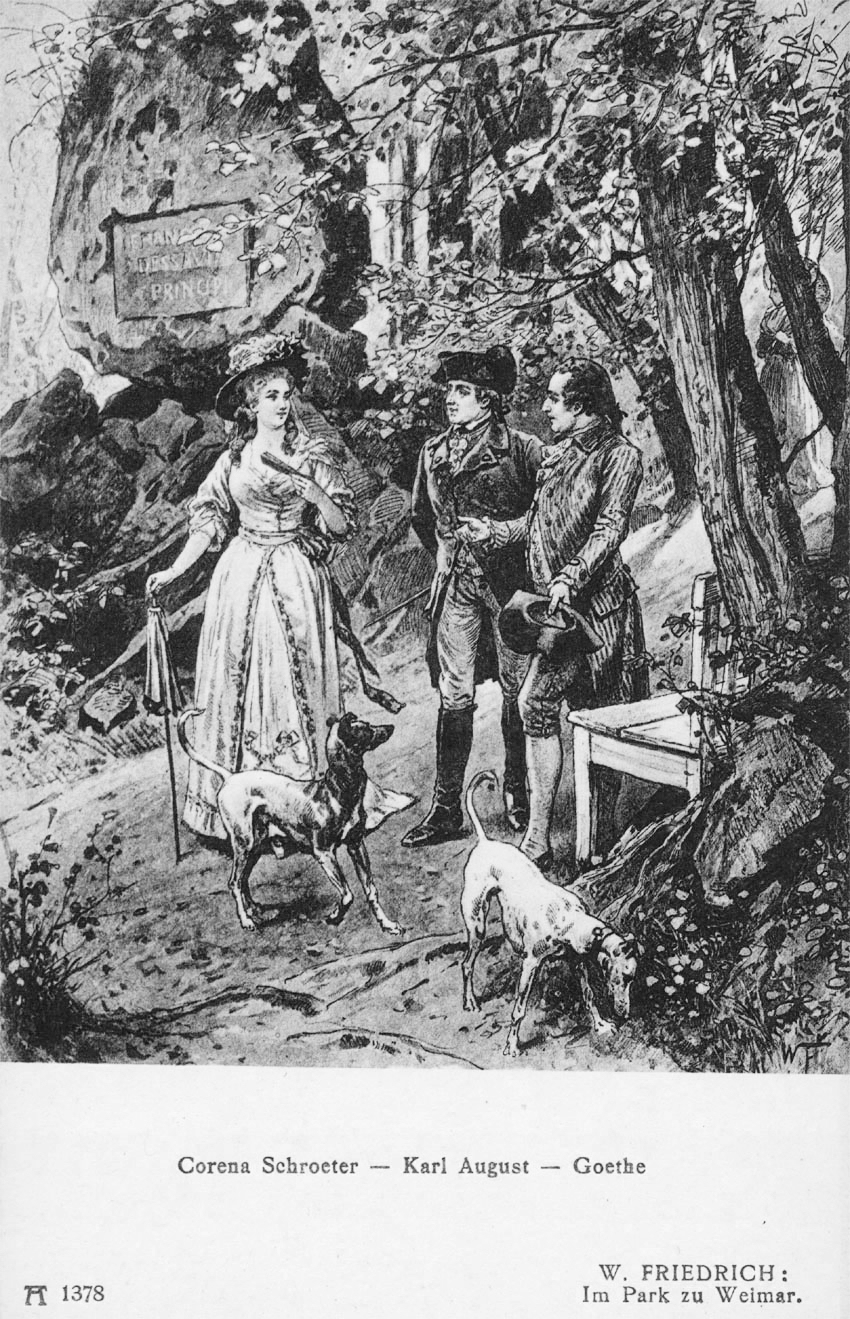
Could it have even been the dogs owned by good old Grand Duke Karl August? He was a great hunter, he had the ways and means of keeping many dogs of all types in his kennels and there are several works of art showing him with what are obviously greyhounds. And he is the guy that is usually credited with creating the Weim.

So maybe the real story is that the Grand Duke didn't actually create the Weim (as I speculate here) but somehow, his dogs managed to contribute a dilution gene to the ancestors of the Weim back when cross breeding and uncontrolled breeding was practiced just about everywhere.

Grand Duke Karl August with Corena Schroeter, Goethe and two Greyhounds


reade more... Résuméabuiyad

'Whitemaraners' Cross-bred or Pure?

I’ve previously written about Weimaraner pups being born with unusually large amounts of white in their coats, I called them ‘Whitemaraners’.  I noted that when photos of such pups are posted, most people automatically assume that the pups are cross-bred, the results of breeding a Weim to a Pointer or to a GSP. And they could be right…sort of. Weim crosses can produce pups with grey and white coats or even solid grey coats but only if they are done for at least two generations.

I don't think that there is any question that such crosses sometimes occur, either by accident or deliberately. But I had never really heard of anyone declaring them publicly...until now. Recently, on the Facebook page of a talented German photographer named Anja Voss, an album of photos appeared showing "Weimaranermix" pups. They are said to be 75% Weim, 25% GSP, ie: the offspring of a Weim and a Weim x GSP cross. The mix of coat colors in the litter is quite interesting. There are solid liver pups, solid grey pups, a liver and white pup and a grey and white pup.

So the bottom line as far as Weim crosses are concerned is that the DNA in both parents must include a copy of the dilution factor responsible for the Weim grey coat color.  In other words, if a pure GSP and pure Weim are crossed, the coats of all the pups simply cannot be grey. They will be brown or black depending on the color of the GSP parent. None will be grey. However, if the GSP parent was not quite as pure as the driven snow, if for example it's a GSP x Weim cross, then it could indeed produce pups with solid grey or grey and white coats if it is bred to a pure Weim, or even if it is bred to another GSP x Weim cross, since both parents can contribute a copy of the dilution factor.

But what about those grey and white pups from other litters that the breeders swore up and down were from purebred parents? Are those breeders lying? Are Weim pups with white coats always the result of cross-breeding no matter what the breeders say?  Or is it in fact possible that pure Weim parents can produce such pups?

As mentioned in a previous post, it has long been suspected that, yes, under certain circumstances, solid grey parents can indeed produce white and grey coated pups. Some geneticists have speculated that if the migration of melanocytes, cells that regulate coat color, is delayed or interrupted during the pups development in the uterus, the pup can end up having a lot of white in its coat at birth. But no one had been able to conclusively prove that theory. There was no smoking gun as it were. That is, until now. 

I can now report that conclusive proof has finally been established for pups with white and grey coats being produced by two solid grey parents. And it is now clear that the theory about disrupted melanocyte migration and proliferation is correct. 

In a recently published paper entitled Spotted Weimaraner Dog Due to De Novo KIT Mutation W.M. Gerding, D.A. Akkad & J.T. Epplen, the same team that examined the molecular genetics of the so-called Blue Weimaraner, describe their investigation into the case of a Weim puppy with white spots born in Germany in a litter of otherwise normal-colored siblings.  I recently interviewed Dr. Epplen about the investigation and the results.

Q: Dr. Epplen, tell me about how the project started.
A: About 2 years ago, a pup with a white spotted coat appeared in a litter of Weimaraners bred in Germany, not far from where I live. It was that breeder’s first litter and, as you can imagine, he was very surprised to see such a pup. His first thought was that it must be due to Pointer blood getting into the line somehow. But he had personally witnessed the mating of the two parents and was certain that his bitch had never been with a Pointer.  So he contacted some more experienced members of the club and the breed warden, Mr. Giesemann and asked them for their opinion and advice. But when they saw the pup and the rest of the litter, they could not understand how it could have such a coat either so they contacted us to see if we could get to the bottom of it.

Q: So what sort of tests did you perform?

A: After collecting DNA samples from the pup, its parents and its siblings, the first thing we wanted to determine was the paternity and maternity of the litter. We wanted to know if the two dogs listed on the breeding documents were in fact the parents of all the pups. Within a week, we had the answer. The DNA clearly proved that the pups were indeed out of the two animals listed as parents.

Q: So you eliminated the possibility of the litter being a result of crossing to Pointers or GSPs?
A: Yes. The pup is a pure-bred Weimaraner, there is no question. Is is not the result of any cross breeding. Its parents are pure-bred Weimaraners from fully tested, recognized lines, approved for breeding by the club.

Purebred Weim pups. The white coat is the result of a 'de novo' gene mutation.

Q: So what tests did you run next? 
A: The next step was to see if there were any mutations in the pup's genetic code that could be responsible for the white in its coat. So we ran DNA sequencing tests on a number of candidate genes that we know are associated with spotting in dogs. Eventually, we found a mutation. We identified it in a gene known as the KIT gene*. Specifically, we found what is known as a gene deletion, a missing portion of the DNA sequence in one very small area. And since the DNA of the parents and the solid-colored grey littermates did not have that deletion, we therefore concluded that the piebalding in the pup’s coat was due to a de novo (new) mutational event that occurred in that one pup’s DNA.

Q: So now that the pup has this new mutation, what would happen if it were bred? Would it produce pups with similar coats?
A: The trait would be transmitted in an autosomal dominant manner as we geneticists say. That means that if she were bred to another pure Weimaraner with a normal coat, any offspring would have a 50% chance of having a spotted coat and a 50% chance of having a normal Weimaraner coat as defined by the official standard.  

Q: What about the parents of the white spotted pup? If they had another litter, would they have more pups with similar coats? The risk for the same breeding pair to produce another white coated pup would be negligible. In fact, they would have the same odds of producing more white pups as any other Weim in the world, less than one in a million.

Q: Have Weim pups with white coats ever been seen before in Germany?
A: The only evidence we have is anecdotal, but I am sure it has happened in the past. However, since white coats were thought to be evidence of cross breeding, or, at the very least a throw-back to Pointers in the Weim’s ancestry, they were hushed up. But in reality, there is always a certain statistical probability that this sort of thing can happen. If you breed enough dogs, you will eventually get this type of mutation. After all, every pup is born with several new mutations in its DNA. But since those mutations rarely result in something that is so highly visible, we don’t really notice them.

Q: What was the reaction of the breeder and of the club?
A: Obviously the breeder was relieved. He was ‘off the hook’ as it were and no longer suspected of allowing his bitch to be bred by a Pointer. It was somewhat of a hot-button issue in the official club since there are some members who would like to see any and all white markings eliminated from the breed, even the small white patches on the chest or toes which have always been in the breed and still occur from time to time today. But in the end it was decided that the affected pup would be registered and accepted as a pure Weimaraner, but not be allowed to breed. Her siblings on the other hand, provided they pass all the breeding tests, will not be forbidden to breed since they are pure Weimaraners and absolutely not affected by the same mutation.


* A gene that plays a role in the development of certain cell types, including the melanocytes that produce the pigment melanin found in the hair, eye, and skin. Mutations to the KIT gene can disrupt melanocyte migration and proliferation during development, resulting in a patterned lack of pigment knowns as piebaldism.

reade more... Résuméabuiyad

The Turkish Pointer's Spanish Connection: Updated

Since my previous post about the Turkish Pointer, I've received a few questions and comments regarding the origins of the breed, its 'double nose' and it's hunting style. Answers/replies below.

Origins: Personally, I believe that the Turkish Pointer is a transplanted Pachon Navarro. The most plausible explanation for it's origin is that somehow, probably in the 1920s or 1930s a small number of Pachones made their way to Turkey from Spain. Over time, a small local population formed in the Tarsus region and became known as the Tarsus Catalburun (Turkish Pointer).

Double Nose: All dogs have a slight crease between their nostrils but it is usually no more than a very shallow line. But many Pachones and Turkish Pointers have nostrils that are clearly divided by a much deeper furrow making it look like the business end of a side-by-side shotgun. This is the famous “double nose” referred to in the old literature.

Anatomically, it is actually a cleavage in the structure of the nose itself. It is not unique to the Pachon Navarro. In fact a good number of breed standards mention a split or double nose but when they do, it is always listed as a serious or disqualifying fault.

A 'double' nose.

It is interesting to speculate just how the double nose came to be viewed as a positive characteristic. It is certainly possible that an individual with a split nose just happened to be an excellent hunter with a very fine sense of smell. Was this then seen as “proof” that at double nose was better than a regular nose?

Nowadays of course, breeders understand that the double nose offers no advantage over a normal nose and that it is simply a cosmetic feature of the breed. Furthermore, not all Pachones and Turkish Pointers have a double nose. Nor do all breeders select for it. Pachon breeders understand that by using double-nosed dogs in their lines, they run the risk of producing pups with completely cleft palates. I was told that up to 10% of pups are either stillborn or are put down immediately after birth since the cleft is so profound that the they are incapable of breathing or nursing properly. But most Pachones have a moderate cleft and are fine. They can breathe and suckle, run and hunt just like any other dog. 

Hunting Style: I found a pretty neat video the other day showing a Pachon Navarro hunting. It is pretty much exactly what we saw in Spain when we were there to photograph them and if you read the old literature from Spain and from England about how the classic old spanish pointers hunted, my guess is that if you could go back 300 years or so and watch the first "Spanish Pointers" brought to England hunting, you would see more or less exactly what is in the video.
"There were Ponto and Tanto, the two great, solemn-eyed, double-nosed Spanish Pointers who lurked in a dignified way about the house, a gentle gloom upon their countenances. They were the grandchildren of the Spanish Pointers owned by my great grandfather, Robert Asplan, the little, old, dapper gentleman who wore black knee-breeches with stockings and silver-buckled shoes. I think those Spanish Pointers knew that their day was done, that they were the last of their race -- gone with the hand-sickle and the centuries of the long September stubbles, where partridges had sit like quails. --  J. Wentworth Day, The Dog in Sport, 1938
Spanish Pointer by George Stubbs (1724-1806)


UPDATE: A recent article by well known Spanish dog expert Dr. Jose Manuel Sanz Timón explores the connection between the Pachon Navarro and the Turkish Pointer. Sanz Timón feels that we may need to re-examine our theories of the Pachon's origin, suggesting that the Turkish Pointer may in fact be its predecessor.

Coincidentally, Sanz Timóns blog post appeared just a few days before this one. However, I was unaware of his post at the time and only read it today, after the good Dr. brought it to my attention. My post on the Pachon-Turkish Pointer connection was inspired by a discussion on the versatiledogs forum that followed my article on the Turkish Pointer published on June 17 and based on breed description found in my book published in 2011.

In any case, I am happy to see that the Turkish Pointer is getting some much needed attention. When I first started researching it in 2008, I could find almost no information on it. But I eventually contacted and interviewed Umit Dincer, who wrote a book about the breed. Now, there are several websites and blogs about the Turkish Pointer and even a few videos on YouTube and elsewhere.

Personally, I am not convinced that the Turkish Pointer predates the pointing breeds developed on either side of Pyrenées mountains in the 13th century. Of course, hunting dogs certainly existed in Turkey, and everywhere else, since the dawn of civilization. But training, selecting and breeding dogs specifically to seek and point game seems to have been a European thing, not an eastern or mid-eastern thing.

The fact that many Turkish Pointers and Pachon Navarros have split noses and other similarities in physical attributes suggests that they may be related, but offers no evidence one way or another for which one came first. In addition, a split nose is actually listed as a fault in many breed standards indicating that it can occur from time to time in just about any breed (in the same way as a cleft palate can occur in humans). In 1913, a small population of dogs with split noses was also found in Bolivia and recently 'rediscovered'. Does that mean they are related to Turkish Pointers and Pachon Navarros? And if so, which one came first?


Read more about the breed, and all the other pointing breeds from Continental Europe, in my book Pointing Dogs, Volume One: The Continentals
http://www.dogwilling.ca/index.cfm

reade more... Résuméabuiyad

Breed of the Week: The Turkish Pointer

Until very recently the Turkish Pointer, a.k.a. the Tarsus Catalburun, was a completely unknown to hunters outside of Turkey. Today, most people still know nothing about it, even in its homeland.


Tarsus is a 2,000-year-old city in south central Turkey. In ancient times it was the capital of the province of Cilicia and was the scene of Mark Antony and Cleopatra’s romance as well as the birthplace of Saint Paul. Today the city is a popular tourist destination and an important industrial center. 

It is known that pointing dogs have been in the region since at least the 1930s, but no one knows exactly how or when they arrived. Some believe that the Turkish Pointer may be an indigenous breed of pointing dog that has been around for centuries. It may have developed in the region long ago and then made its way to western Europe, either while much of Spain was under Arab control in the 8th to 11th century, or when European Crusaders returned from the Middle East in the 12th century. If so, then the Turkish Pointer would be the great-grandfather of all the pointing breeds in the world today.


A Turkish origin for all pointing dogs is an intriguing idea, but it is not supported by the available evidence. No one disputes the fact that certain types of dogs were introduced to western Europe from the Middle East and North Africa. But there is no reason to believe that any of them were pointing dogs, and many reasons to believe that they were not. As we’ve seen in the historical overview in the Introduction, pointing dogs have never been a part of Middle Eastern or Asian hunting traditions. Even today hunters still practising traditional Oriental hunting methods do not employ pointing dogs of any kind. It is also quite telling that there are no illustrations, photos or written references to pointing dogs in the Tarsus area before the 1930s.

So it is far more probable that the Turkish Pointer is in fact a sort of landrace that developed in the Tarsus region out of a nucleus of European dogs imported in the 19th century. The Turkish Pointer has a classic shape and hunting style that harkens back to a bygone age and, like the Pachón Navarro, it has a “double nose”. In fact, its name in Turkish, Catalburun, is derived from this trait; catal (pronounced chatal) means “fork” and burun means “nose”. 


In terms of hunting style and ability, the Turkish Pointer works in much the same way as the Pachón Navarro. It is mainly used to hunt partridges and rabbits and, despite a rather thick build, it is said to be quite agile. Umit Dinçer, who wrote an excellent book on the breed, told me that: 
They generally hunt at a trot but will occasionally gallop, depending on the cover they are working. Since the breed is most often used in very bushy terrain or areas of thick grass, it is a very close worker, typically staying within 25 to 30 meters from the hunter. They tend to be good pointers and they are natural retrievers with a soft mouth, as well. There is no specific effort to select for tracking but the more the dogs practise, the better they get. These dogs track, stalk, find and retrieve game. Giving voice is common and desired. The Turkish Pointer is mostly an upland dog but if they are trained, they may be successful at swimming, too. The breed was originally found in the Tarsus area, but nowadays you can see a few in other regions of the country. People who have them are basically hunters. The Turkish police force is interested in using the breed as narcotic detectives as well. But numbers are decreasing because it is not under the protection of any official club. It must be protected and officially known. 
Recently, the municipality of Tarsus has applied to the Turkish Patent Institution to register it as a breed. Due to the limited gene pool, all current Turkish Pointers are heavily inbred, but so far no known hereditary health issues have been reported. Recently a few websites and blogs about the breed have popped up  online and there is an interesting video (in Turkish) about the Tarsus Catalburun on Vimeo:


Digitürk İZTV Çatalburun AV Köpekleri Belgeseli from Adana_DT on Vimeo.


Read more about the breed, and all the other pointing breeds from Continental Europe, in my book Pointing Dogs, Volume One: The Continentals
http://www.dogwilling.ca/index.cfm
reade more... Résuméabuiyad

Breed of the Week: The Russian Setter

In October 1823, an illustration of a rough-haired dog retrieving a pheasant appeared on the cover of the The Sporting Magazine. The caption beneath the image read “Basto, A Russian Setter”. A description of Basto appears inside.

Basto is of Russian parents, which were highly valued in this country, and their offspring has in no way disgraced the character of these setters! He is distinguished in the lower parts of Surrey and in Sussex as an excellent finder, and of very delicate mouth. Basto brings his game, and has scarcely ever been known to lose a wounded bird, in either corn, furze, or water, which he takes and hunts with the same ease as a smooth-haired pointer hunts a stubble! Basto, like all sporting dogs of Russian blood, is slow, but he often picks up birds, hares, and pheasants, that a fast-hunting pointer has passed in the field. He is about eight years old, and the property of T. Gilliland, Esq.

References to the Russian Setters are relatively common in 19th century English sporting literature, but they are often so highly polarized and contradictory that it is hard to form an accurate picture of what they were really like. In terms of appearance, John Henry Walsh, also known as Stonehenge wrote that:
The actual form of the Russian Setter is almost entirely concealed by a long woolly coat, which is matted together in the most extraordinary manner. He has the bearded muzzle of the Deerhound and Scotch Terrier but the hair is of a more woolly nature, and appears to be between that of a Poodle and the water spaniel
Robert Leighton, who also mentions a “Russian Retriever” in the New Book of the Dog , says of the Russian Setter that:  
There are two varieties of the breed and, curiously enough, they are distinguished from each other by the difference in their color. The dark-colored ones are deep liver and are curly-coated. The light colored ones are fawn, with sometimes white toes and white on the chest; sometimes the white extends to a collar on the neck. These latter are straight-coated, not curly like the dark ones.
Some descriptions read as if they were written by men who had never laid eyes on a Russian Setter. In Biographical Sketches and Authentic Anecdotes of Dogs, Thomas Brown provides a summary of the breed that is clearly no more than bits and pieces taken from descriptions of other pointing breeds. He even seems to confuse Russia with Spain, claiming that the Russian Setter had a cleft nose and was called the 'Doublenosed Pointer'.
There is one peculiarity about him, which is, that his nose is so deeply cleft that it appears to be split in two, on which account he is termed in Russia the Doublenosed Pointer. His scent is said to be superior to that of the smooth dogs. This cleft nose is found to be inconvenient when he is beating in cover, as the face is apt to be torn where the brushwood is thick.
Other descriptions were from more reliable sources such as Edward Laverack, the man who litterally wrote the book on setters.
Russian (behind) English and Irish Setters
These dogs are but little known in this country. The late Joseph Lang's I have repeatedly seen. Two of them were brought down by Mr. Arnold, of London, to my shooting quarters, Dunmaglass. He had given thirty guineas a-piece for them as puppies, and had them very carefully broken by an English keeper. They were not at all good specimens of the class, and, as working dogs, comparatively useless. So disgusted was he with them before he left, that he shot one, and gave the other away. I have never seen but one pure specimen, which was in the possession of the late Lord Grantley, at Rannoch Barracks, head of Loch Rannoch, Perthshire. This dog was a magnificent type of the Russian setter, buried in coat of a very long floss silky texture; indeed he had by far the greatest profusion of coat of any dog I ever saw.
They were good but most determined, wilful, and obstinate dogs, requiring an immense deal of breaking, and only kept in order and subjection by a large quantity of work and whip; not particularly amiable in temper, but very high-couraged and handsome, an enormous quantity of long silky white hair, and a little weak lemon colour about the head, ears, and body ; and their eyes completely concealed by hair.
'Old Calabar' got a brace of these puppies, had them well broken, and took them to France ; but, after shooting to them two seasons, and being disgusted with their wilfulness and savage dispositions (they would take no whip), sold them to a French nobleman for a thousand francs (40/.), and considered he had got well out of them.

Reading through the old literature, it is clear that the terms “Russian Setter” and “Russian Pointer” were used to describe any rough-coated pointing dog in Britain at that time. Similar, if not identical dogs were called Smousbaarden in the Netherlands, Griffons in France and Polish or Hungarian Water Dogs in Germany. Before the late 1800s, none of them were 'pure' or independent breeds. They just represented a type of dog that was found just about everywhere sportsmen took to the field. A rough coat was their most distinctive feature and it was probably the reason men in Britain called the dogs “Russian”. It was commonly believed that people from the frozen eastern regions, and their dogs, were rather hairy and unkempt. In an article from The Farmer's Magazine in 1836, we can see just how politically incorrect many of the writers were at the time.
We may perhaps have seen a dozen of these brutes, which, like the people whence they derived their grossly misapplied appellation, are very uncouth very rough, imperturbably stupid, and, by way of continuing the similarity to the greatest possible extent, will generally be found infected with loathsome vermin.
Thomas Burgeland Johnson's description of what he called the "Russian Pointer" in the 1819 issue of The Shooter’s Companion equally negative. 
Whether he be originally Russian is very doubtful; but he is evidently the ugliest strain of the water-spaniel species; and, like all dogs of this kind, is remarkable for penetrating thickets and bramble bushes, runs very awkwardly, his nose close to the ground (if not muzzle-pegged), and frequently springs his game. He may be taught to set, and so may a terrier, or any dog that will run and hunt, and even pigs, if we are to believe the story of Sir Henry Mildmay’s black sow; but to compare him with the animals which have formed the subjects of the two preceding chapters (setters and pointers), would be outrageous: nevertheless, I am not prepared to say, that out of a hundred of these animals, one tolerable could not be found; but I should think it madness to recommend the Russian Pointer to sportsmen, unless for the purpose of pursuing the coot or the water-hen.

Mixing Russian Setters with other breeds is sometimes mentioned.  The results of a crosses "...between the Russian setter and the smooth pointer" are given in Dogs of the British Islands.
... I must admit that the Russian and pointer cross has produced dogs that for work could not well be surpassed. I may, perhaps, have been fortunate in the specimens seen, but do not speak from one or two, but many. In appearance, however, they are not to be compared to the thorough-bred pointer or setter, though more elegantly shaped than the Russian. There is another peculiarity in this breed worthy of notice. You may go back to the Russian with favourable results. I shot over a brace so bred on the moors last season, that would be hard to beat for range, keenness of scent, and sagacity.
References to Russian Setters in America are scarce, but there are a few and one in particular is quite well known: the first Korthals Griffon to be registered with the AKC, a bitch imported from France, was listed as a "Russian Setter (Griffon)". In The Complete Manual For Young Sportsmen, Henry William Herber (aka Frank Forester) wrote that Russian Setters were:
... rarely or never met with in this country. Could they be procured, I think of all sporting dogs they are the most adapted for ordinary American shooting, and the best of all for beginners. They have less style, and do not range so high as the English or Irish dogs, but that is no disadvantage for America, where there is so much covert shooting.
The Russian Setter never really achieved the status of an independent breed of pointing dog. I must have been just as difficult to stabilize as any other strain of griffon. And without a British Eduard Korthals or Emmanuel Boulet to champion its cause and perfect its breeding, the Russian Setter soon faded from the scene.


Classified ad the French sporting newspaper Le Chenil, 1884. "For sale, Red Russian Setter, 11 months old, obedient, points well, good nose, works well in water, easy to train. Price: 55 Francs. Contact M. L. Vince, Hessle House Hadleigh, Suffolk


Read more about the breed, and all the other pointing breeds from Continental Europe, in my book Pointing Dogs, Volume One: The Continentals
http://www.dogwilling.ca/index.cfm

reade more... Résuméabuiyad