Pages

.

Versatility Part 1: Reporting From Finland


In the gundog world, the term 'versatile' is pretty versatile. In the UK, France, Italy and other European countries, it means a dog that hunts, points and retrieves. In North America, according to NAVHDA, it means a dog that hunts, points, retrieves and tracks on land and water. In Germany and countries to the east, it means a dog that hunts, points, tracks, drives, bays, flushes, kills vermin and protects the house and home.  

But even as broad as those definitions are, they still don't cover the full spectrum of how versatile dogs are actually used by hunters in each region. So in this next series of posts, I would like to explore some of the more interesting and unusual ways that versatile dogs are used in different parts of the world. Today's post will look at something called "reporting" done by Finnish hunters, field trialers and their dogs in the vast forests of Finland.


Imagine a dog searching for game in a large field or forest, beyond the sight of the handler. Suddenly, it points. Then, after a while, it leaves the point, runs back to find its handler in order to lead him back to the place where the original point occurred. Once there, it points again. 

The dog has just done what the Finns call Tiedotus which means 'reporting' or 'announcing'. It is a technique used by Finnish hunters when they hunt grouse and is also a requirement of high-level 'winners class' field trials. Here is a more detailed description of how it works:

1. The dog, while hunting out of sight of the handler, sticks a point.

2. After a while, if the handler doesn't show up, the dog leaves the point to go get the handler OR, the handler, not seeing the dog and assuming it is on point somewhere over yonder whistles for it to come back in so that the dog can lead him back to the original scene of the point.

3. If it is done during a trial, the handler must tell the judge that his dog is reporting. He/she cannot say "I think the dog might be reporting" or "I think I should whistle him to see if he will report", it has to be a solid declaration. The handler must say something like "Judge, my dog is reporting" or "I am going to whistle to make my dog report". 

4. Once the reporting is "declared", the judge starts evaluating how well the dog cooperates with the handler, specifically how well the dog keeps contact with the handler while returning to the point. Ideally, the dog should return quickly to the handler, but while going back to the scene of the point it should go more cautiously, keep close contact with the handler and work in silence.

5. Once the dog is back on point, with the handler close by, and if the situation allows, the handler or shooter may shoot the bird if given permission by the judge.

So there you have it, a pretty cool hunting technique if you ask me. But one has to wonder how and why the Finns came up with it. Personally, I have a hunch that it may have been developed because the Finns hunt a lot of Capercaillie, huge black grouse that often sit in trees and/or hold well for points in the forest since they are highly territorial and tend to 'stand their ground', even when facing a dog or a man.
Click photo to see a crazy video of a brave Capercaillie in Russia.
A traditional way of hunting Capercaillie in Finland is with Spitz type dogs that tree them and bark to alert the hunter who then approaches and shoots the grouse with a rifle. Could 'reporting' be a modern versatile dog adaptation of that technique?


If so, how do they train for it? And can breeders actually select for dogs that do it naturally? According to Finnish hunter and breeder of Picardy Spaniels, Jani Rajaniemi, the answer to both questions is 'yes'.
"Reporting is mainly something that some dogs do naturally. Of course you can encourage it through training, but it is almost impossible to teach it to a dog that does not want to do it naturally. There are some breeds and lines that have a lot of natural ability for it, German shorthairs from Finnish and German lines especially."

Here is a video showing how to develop Tiedotus in a young dog:


And here is an older dog:


And here is Tiedotus in a real hunting situation


reade more... Résuméabuiyad

How to Pass the Time Till Opening Day.

The 2013 hunting season is over 6 weeks away and I'm already getting the itch! But I've found that one way to pass the time between now and opening day - besides enjoying some fine sipping whiskey and gorgeous summer weather - has been to revisit some of our photos from last year. 

Here are a few from last November when Lisa and I met up with good friends Judy and Vince Balog for our annual South Dakota pheasant hunt. Judy, Vince and I were armed with shotguns. Lisa was armed with a Canon...camera. 


reade more... Résuméabuiyad

Where did the Weim get its color?

All theory, dear friend, is gray, but the golden tree of life springs ever green.
Johann Wolfgang von Goethe


The Weimaraner has a unique grey coat inherited from the Grey Dogs of King Louis. Right?

Wrong.

The Weim's coat is not grey, it is not unique, and it didn't come from any 'Grey Dogs of King Louis'.

OK, I can practically hear the bloomers bunching up right now and you are probably doing this:
but please,  hear me out.


The Weimaraner's coat is not grey. It is brown. However, a mutation in the MLPH (Melanophilin) gene causes an uneven distribution of the brown pigment that leads to the formation of large granules (macromelanosomes) in the hair follicles and shafts. So instead of looking similar to a solid brown GSP type coat, the Weim coat appears as a 'diluted' brown which Weim folks call "grey" or "silver-grey". If a dog with a black coat has the same mutation, the uneven distribution of pigment leads to a similarly diluted appearance. In Weim circles, dilute black is called 'blue'.

Ok, so if the Weim's coat is brown (or black) but is diluted by a mutation, where did that mutation come from?

Short answer: no one really knows.

Long answer: While it is possible that a spontaneous mutation occurred in hunting dogs in the area around Weimar sometime in the mid to late 1800s, it is far more likely that a mutation occurred centuries before the Weim was even on the drawing board and was then brought in by one or more of the types of dogs used to create the Weimarner in the mid 1800s. But what kinds of dogs could have brought it in ?

One of the most oft repeated theories is that it came from the Chiens Gris (grey dogs) of Saint Louis of France. But as I explained in a previous post, King Louis’ dogs weren't actually grey. They were tri-colour black, brown and red.

Saint Louis' Chiens Gris (grey dogs)
Another theory is that the grey came from crossing a "lemon" (orange and white) Pointer bitch to an old style German "Leithund" (tracking dog). However, the lighter pigment in lemon Pointers is caused by a mutation in the the MC1R gene, not the MLPH gene. Could the dilution mutation come from the Leithund? Maybe, but we don't really know what color the old Leithunds were and none of the old literature says anything about 'grey' ones. The closest thing we have to Liethunds today are breeds like the Bayerischer Gebirgsschweißhund (Bavarian Mountain Hound), and they are a reddish brown color.
Bavarian Mountain Hound
Lemon Pointer
So what we need to find is a breed or type of dog that a) had a grey coat, b) was relatively common in the area around Weimar before the 1800s and c) was owned by people ready and able to undertake a breeding program that could eventually lead to a new 'pure' breed of hunting dog.

If you read the old literature and look at old paintings and sculptures, one breed stands out. It had a grey coat, it was relatively common in Germany and elsewhere in Europe in the 1800s and it was popular among the nobility. The breed is the Italian Greyhound.

A reenactor as Frederick the Great with two grey Italian Greyhounds
Now that is not to say that the Italian Greyhound was specifically used in the creation of the Weimaraner as a hunting dog. But at a time when 'pure' breeds of dogs did not really exist and cross breeding was widely practiced, it is entirely possible that somehow, the dilution gene that was already in the Italian Greyhound somehow made its way into the dogs that were eventually used to create the Weim. After all, in an article entitled One coat color — one breed? Wanda M. Gerding & Jörg T. Epplen, Human Genetics, Ruhr-University Bochum, German state that "...the b-gene version  found in the Italian Greyhound is virtually identical to one of the three b-alleles found in the Weimaraner".

Italian Greyhounds were also relatively popular in Germany just before the development of the Weim and among people who had the means to undertake a breeding program. The Italian Greyhound was in fact the favorite dog of Germany's Frederick the Great (1712 – 1786). However, Frederick the Great was not a hunter, but actually one of the earliest supporters of animal rights. So he was probably not involved in any efforts to create a new breed of gundog. But other nobles in Germany who had Italian Greyhounds and enjoyed hunting may have been. Could their dogs have been the source of the dilution gene that made its way into Weim lines?

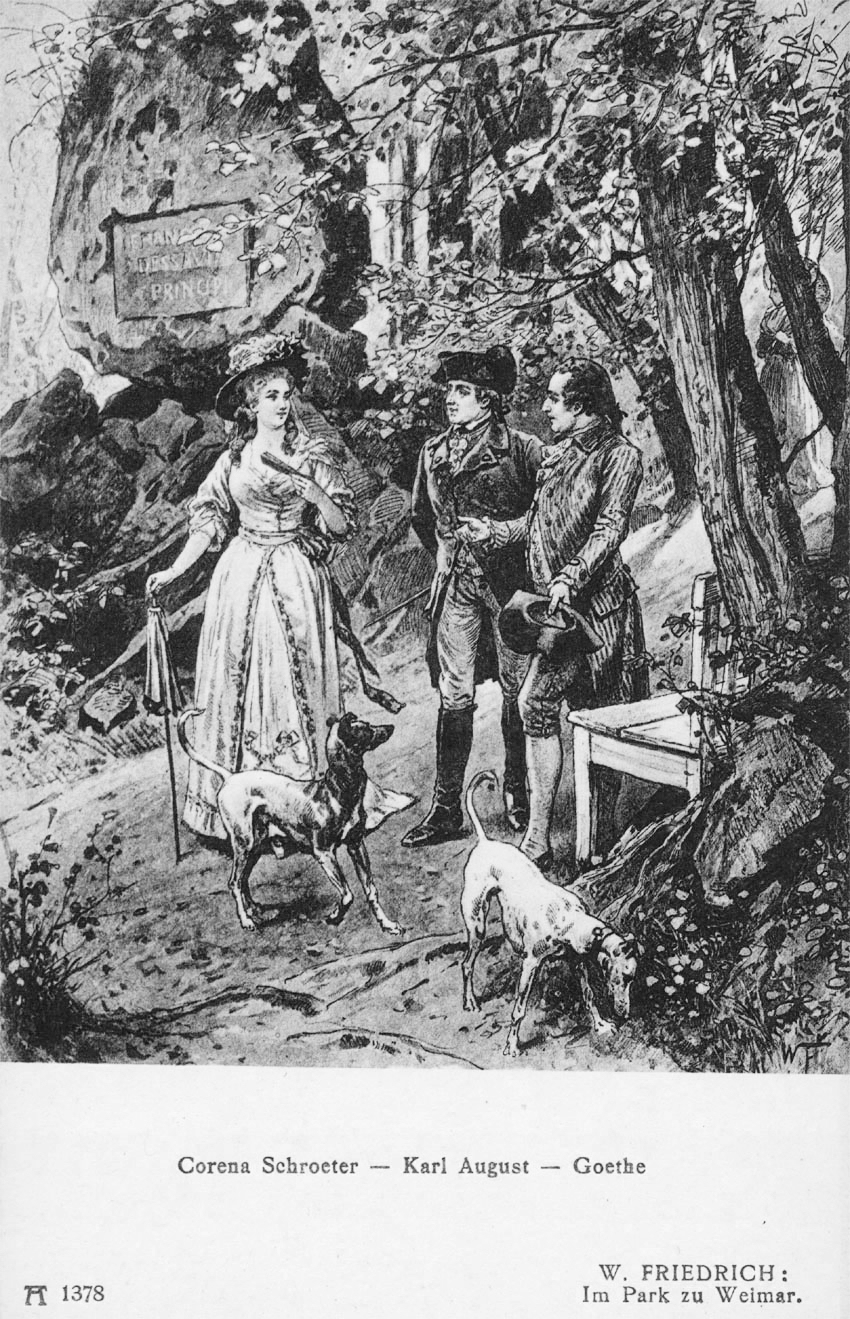
Could it have even been the dogs owned by good old Grand Duke Karl August? He was a great hunter, he had the ways and means of keeping many dogs of all types in his kennels and there are several works of art showing him with what are obviously greyhounds. And he is the guy that is usually credited with creating the Weim.

So maybe the real story is that the Grand Duke didn't actually create the Weim (as I speculate here) but somehow, his dogs managed to contribute a dilution gene to the ancestors of the Weim back when cross breeding and uncontrolled breeding was practiced just about everywhere.

Grand Duke Karl August with Corena Schroeter, Goethe and two Greyhounds


reade more... Résuméabuiyad